
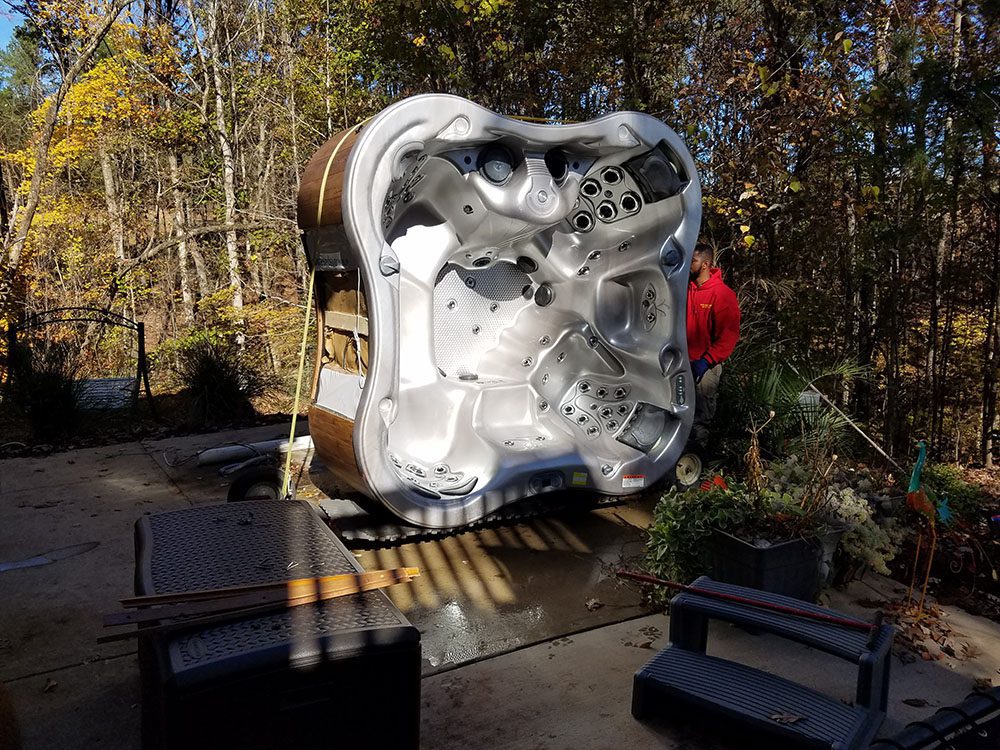
People usually ask this question for one of two very different reasons, and the honest answer depends on which one applies to you. Some people are picturing a narrow gate, a tight stairwell, or a fence line that a hot tub won’t clear standing upright. Others are picturing loading it into a truck bed on its side and driving it across town, or across the state, that way. Those aren’t the same risk, and most articles on this topic treat them as if they were.
We’ve been moving hot tubs and swim spas since 1994, so this isn’t theoretical for us. Here’s the real answer, and more importantly, why.
The Short Answer: It Depends on “On Its Side” for How Long
A brief, controlled tilt to clear an obstacle, properly padded and supported, is a normal part of how professional movers handle tight spaces. Sustained transport lying flat on its side for a long drive is a different matter entirely, and it’s where most of the real damage happens. The difference isn’t really about the angle. It’s about how long the shell and its internal components are asked to bear weight they were never designed to carry, and how well that weight is supported while it happens.
What’s Actually Inside the Shell That Makes This Risky
A hot tub isn’t a simple molded tub sitting on a frame. Underneath the acrylic shell, most tubs have an equipment bay housing the pump, heater, and control system, connected to the jets through a network of PVC plumbing unions. In many modern spas, foam insulation is sprayed directly against the underside of the shell, where it not only holds heat but also provides real structural support, helping the shell hold its shape under the weight of water and bathers.
That’s the part people miss. The acrylic shell was engineered to be supported by water pressure and the cabinet frame when it’s sitting upright and full, or by the frame alone when it’s empty and upright. Lay it on its side, and the weight distribution changes completely. Depending on which side goes down, either the equipment bay and its plumbing unions, or a section of shell never meant to bear point-load weight, ends up carrying stress it wasn’t built for.
Tilting to Clear an Obstacle vs. Hauling It Down the Highway on Its Side
This is the distinction most guides skip entirely. A short, supported tilt, maybe thirty to forty-five seconds to get through a gate or around a stair landing, with padding at the contact points and people controlling the weight the whole way, is standard practice. It’s not risk-free, but it’s a brief, managed event.
Sustained side transport is a different category of risk. Over miles of road vibration, potholes, and highway speed, the same stress that’s momentary during a tilt becomes continuous. That’s when plumbing unions can loosen or crack, sometimes without showing a leak until the tub is refilled at the destination. It’s also when foam insulation can start to separate from the shell in spots, creating a void that won’t cause a visible problem immediately but can lead to shell flexing and cracking once the tub is filled with water again.
What Actually Breaks When It’s Done Wrong
- Cracked or stressed plumbing unions, discovered only after refilling, when a slow leak shows up behind a panel.
- Foam insulation separating from the shell, which doesn’t always show up right away but can lead to shell cracking under the weight of water later.
- Stress fractures at shell seams or corners, especially on tubs laid on the equipment-bay side, where there’s less structural backing.
- Cabinet frame warping or panel damage from the tub’s weight resting on a corner or edge it wasn’t designed to bear.
Why Warranty Coverage Is Part of This Decision Too
It’s not just physical risk. Spa manufacturers generally tie warranty coverage to following the instructions in the owner’s manual, including how the spa is handled and installed, not just how it’s operated day to day. Bullfrog Spas’ owner’s manual, for example, states plainly that warranty coverage can be voided by failing to install, maintain, and handle the spa according to the manual’s recommendations. If you’re moving a tub that’s still under warranty, check that paperwork before deciding to handle a side transport yourself.
If You’re Moving It Yourself: How to Reduce the Risk
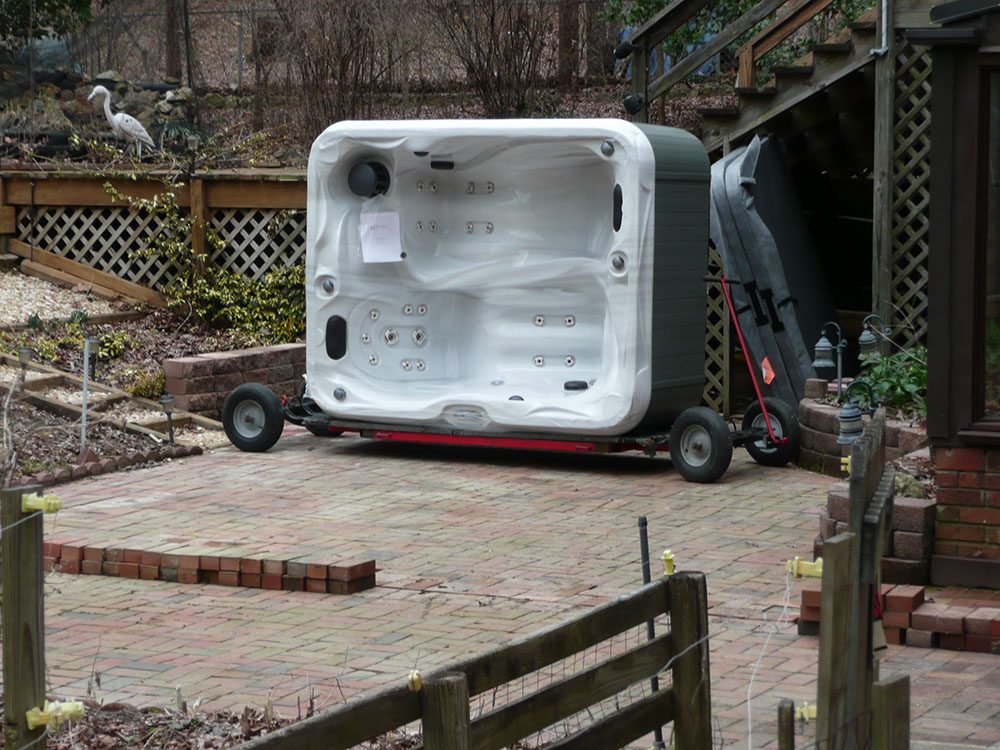
- Drain the tub completely before any tilting or transport; even a few gallons of retained water adds unpredictable shifting weight.
- Disconnect power at the breaker, not just the local disconnect, before doing anything else.
- Remove loose components like pillows, jet inserts, and the cover, so nothing shifts or gets crushed.
- Pad heavily at every contact point, particularly the corner or edge that will bear weight if any tilting happens, and especially over the equipment bay.
- Use a rated furniture dolly built for heavy loads rather than dragging or sliding the tub across any surface.
When It’s Worth Calling in a Professional Mover
Tight gates, narrow side yards, second-story decks, and fenced-in patios are exactly the situations where a brief controlled tilt done wrong turns into a cracked shell or a torn union. If your move involves any of those obstacles, or the spa needs to go any real distance, that’s usually when it makes sense to bring in a crew that does this daily rather than a handful of times in a lifetime. We even offer cranes for limited-access moves when a gate, fence line, or elevation change rules out a standard dolly move entirely, something most general moving companies aren’t equipped to handle.
Frequently Asked Questions
Can you lay a hot tub on its side to move it?
Briefly and carefully, yes, particularly to clear a tight obstacle. Extended transport lying on its side carries real risk to the plumbing unions and foam insulation and should be done with heavy padding and support, or left to professionals with the right equipment.
How long can a hot tub safely stay on its side?
There’s no universal safe duration; it depends on the model, how well it’s supported, and which side is bearing the weight. Treat it as a brief, controlled maneuver rather than a transport position whenever possible.
Does moving a hot tub yourself void the warranty?
It can, depending on the manufacturer. Many owner’s manuals tie warranty coverage to proper installation and handling, and some extended warranty or dealer agreements specifically require professional relocation. Check your paperwork before deciding.
How many people does it take to move a hot tub?
Most standard-sized tubs require at least four people, and larger or heavier models often need six, along with a rated furniture dolly. This isn’t a job for two people regardless of how strong they are.
How much does it cost to have a hot tub professionally moved?
Pricing depends on the spa’s size, the distance traveled, and how many movers the job requires, since a straightforward driveway relocation costs less than a long-distance move involving stairs or limited access.
Get It Moved the Right Way
A hot tub is a significant investment, and the difference between a clean move and an expensive repair often comes down to exactly the details covered here: how long it’s on its side, how it’s supported, and whether the person handling it understands what’s actually inside the shell. If your move involves anything more complicated than rolling a tub across a flat driveway, Hot Tub Taxi has been handling exactly these situations since 1994, and our hot tub moving services cover everything from local relocations to long-distance transport and limited-access crane moves across NC, SC, VA, TN, GA, and FL.