
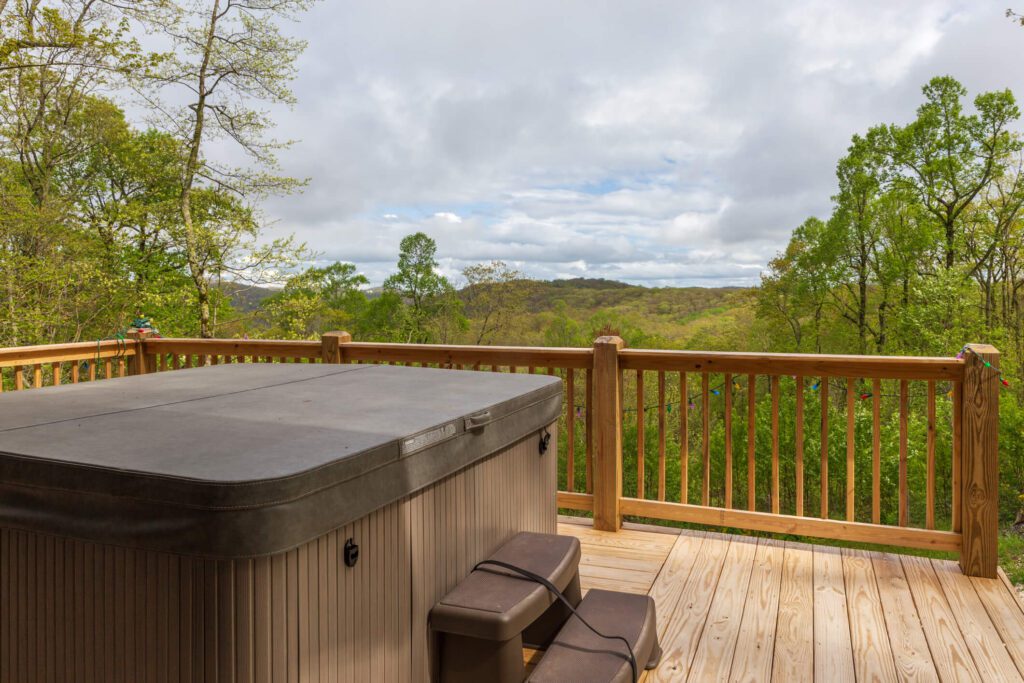
Yes, a hot tub can be moved off a deck, and it’s one of the more common calls we get. But the question worth asking isn’t really “can it be done.” It’s “what’s this deck actually been holding up for the last several years, and is it still able to hold that weight while it’s being moved.” Most moving guides skip that question entirely and jump straight to doorway measurements and how many people you’ll need. On a deck, that’s often the wrong place to start.
Why Decks and Hot Tubs Are a Structural Mismatch From Day One
Here’s something most homeowners never hear until a mover or inspector points it out: a standard residential deck isn’t built to carry a hot tub’s weight the way most people assume. The International Residential Code, published by the International Code Council, sets the minimum live load for a residential deck at 40 pounds per square foot, enough for people, furniture, and a grill spread across the surface. A filled hot tub doesn’t spread its weight out that way. A mid-sized spa full of water commonly works out to somewhere between 80 and 150-plus pounds per square foot concentrated over its own footprint, well beyond what a standard deck was designed to carry without reinforcement.
In practice, that means one of two things is true about the deck your tub is sitting on: either it was specifically reinforced when the tub went in, with doubled joists, a supplemental beam, or dedicated footings under that section, or it’s been quietly carrying more localized weight than it was ever designed for. Most homeowners don’t know which applies to their deck, and that’s exactly what’s worth knowing before, not during, a move.
The Rot You Often Can’t See Until the Tub Actually Moves
This is the part almost nobody warns you about, and it’s the reason a deck-based hot tub move deserves more caution than a driveway or garage move. A stationary hot tub blocks sunlight and airflow to the deck boards and framing underneath it, while regular splashing and condensation keep that same area consistently damp. That combination, moisture plus no airflow, is close to ideal conditions for wood rot, and it’s happening in exactly the spot you can’t inspect without moving the tub out of the way first.
We’ve seen this play out more than once: a deck that looks perfectly solid everywhere else has soft, discolored, or genuinely compromised framing directly under and around where the tub sits. That’s not a reason to panic, but it is a reason to have the deck actually assessed as part of the move plan, rather than assuming the last several years of “it’s been fine” means it’s still fine right now.
Ground-Level Decks vs. Elevated Decks: Different Move, Different Risk
A low, ground-level deck and a raised second-story deck aren’t the same job, and treating them the same is where a lot of DIY attempts go wrong.
On a ground-level deck, the main risks are gaps between deck boards catching a dolly wheel, railings or gates too narrow to clear the tub, and, as covered above, any soft or rotted framing discovered along the way. With a structurally sound deck and enough clearance, a careful dolly move is often realistic.
On an elevated deck, the math changes. Walking a tub down a flight of exterior stairs means asking stair framing, which has its own load requirements separate from the main deck, to briefly carry a large, awkward, concentrated weight it wasn’t built to handle as a moving load. This is exactly the kind of situation where a controlled lift clear of the structure, rather than a walk-down, is the safer call.
What We Actually Check Before Moving a Tub Off a Deck
- Ledger board attachment where the deck connects to the house, since this is a common failure point on older or improperly flashed decks.
- Joist condition directly under the tub’s footprint, checking for soft spots, discoloration, or give that wouldn’t show up anywhere else on the deck.
- Post and footing condition, especially on any support added specifically for the tub.
- Railing and gate width, and whether any section can be safely removed without compromising the rest of the structure.
- Stair capacity, if stairs are part of the planned route off the deck at all.
If You’re Attempting a Ground-Level Deck Move Yourself
- Drain the tub completely and disconnect power at the breaker before doing anything else.
- Lay down plywood runners across the deck boards to distribute the dolly’s weight rather than concentrating it on a few boards at a time.
- Remove railing sections in advance rather than trying to force the tub past a gap that’s slightly too narrow.
- Stop if you find anything soft, spongy, or discolored in the decking or framing. That’s not a detail to push through; it’s a sign the plan needs to change.
When It’s Worth Calling a Professional Mover
Any elevated deck, any sign of rot or structural uncertainty discovered along the way, or a railing and gate situation that can’t be resolved without real disassembly are all good reasons to bring in a crew that handles this regularly, not just a handful of times in a lifetime. This is also exactly the scenario our hot tub moving services are built around: when a standard dolly route off a deck isn’t a safe option, we can lift the tub clear of the structure entirely with a crane rather than risking the deck, the tub, or the crew trying to force it down a route it was never meant to handle.
Get It Off the Deck the Right Way
A deck can hide exactly the kind of structural issue that turns a routine hot tub move into a real problem, which is why we treat every deck removal as a structural question first and a logistics question second. If your tub is sitting on a deck and it’s time for it to go, Hot Tub Taxi has been handling exactly this kind of move since 1994, and our hot tub moving services, including crane removal for limited-access and elevated situations, cover NC, SC, VA, TN, GA, and FL.
Frequently Asked Questions
How much weight can a deck actually hold for a hot tub?
Standard residential decks are built for 40 pounds per square foot of general use. A filled hot tub commonly exceeds 80 to 150 pounds per square foot over its own footprint, which is why hot tubs typically require reinforced framing beyond a standard deck build.
Can a hot tub sit safely on a regular, unreinforced deck?
Not reliably over the long term. Without added support such as doubled joists or a dedicated beam under the tub, a standard deck is carrying more concentrated weight in that spot than it was designed for, even if there’s no visible problem yet.
How do you get a hot tub off a raised or second-story deck?
For elevated decks, a crane lift clear of the structure is generally the safer approach over walking the tub down stairs, since stair framing isn’t built to carry that kind of concentrated moving load.
Do you need a crane to move a hot tub off every deck?
No. A structurally sound, ground-level deck with enough clearance can often be moved with a proper dolly. Elevation, narrow access, or any sign of structural concern are what typically push a job toward a crane.
Can you move a hot tub off a deck without draining it first?
No. Always fully drain a hot tub and disconnect it from power before moving it, on a deck or anywhere else; the added weight and shifting water make an already heavy object much harder to control.