
Most advice on this topic comes from one of two sources: a junk removal company that makes money hauling your hot tub away, or a spa dealer that makes money selling you a new one. Neither has much reason to tell you a repair might actually be the better call. We do both repair and disposal here, which means we don’t have a stake in pushing you toward either one. So here’s the honest version: how to actually tell the difference between a hot tub that’s worth fixing and one that’s genuinely done.
The Short Answer
A hot tub is usually worth disposing of when repair costs approach or exceed roughly half of what a comparable replacement would cost, when problems are compounding rather than isolated, or when the shell itself, not just a component, has failed. A single broken part on an otherwise sound tub is almost always worth fixing. Multiple major systems failing at once, especially on a tub already past its typical 10 to 15 year lifespan, usually isn’t.
The 50% Rule: A Real Way to Decide
Appliance and HVAC technicians have used a simple guideline for decades: if the cost to repair something exceeds about half of what a new replacement would cost, replacement is usually the better financial move. The same logic applies cleanly to hot tubs. A single pump replacement or a heater element, typically a few hundred dollars, is nowhere near that threshold on a tub that otherwise runs fine. But if you’re looking at a new pump, a new heater, and a control pack all in the same estimate, the math often flips, especially once you factor in that older tubs tend to keep presenting new problems every season once they start failing.
Signs That Usually Point to Repair, Not Disposal
- A single failed component, like a pump, a heater element, or a control board, on a tub that’s otherwise structurally sound and reasonably maintained.
- A tub under 8 to 10 years old with no history of major prior repairs.
- An isolated leak traced to a specific fitting or seal rather than a crack in the shell itself. These are frequently repairable at a fraction of replacement cost.
- Cosmetic wear, like a faded cabinet or a worn cover, that doesn’t affect function at all.
In these situations, getting an actual repair estimate before assuming the worst is almost always worth the phone call. We’ve seen plenty of hot tubs written off as “done” by an owner who never got a second opinion, when the actual fix was a single part.
Signs That Genuinely Point to Disposal
- Multiple major systems failing at once, such as the pump, heater, and control pack all needing replacement in the same season. Individually, any one of these might be worth fixing. Together, the cumulative cost usually clears the 50% threshold fast.
- A cracked or structurally compromised shell. Unlike a leaking fitting, a genuine shell crack is often not economical to repair, particularly on an older acrylic shell, and can worsen over time.
- Persistent, unresolved leaking after previous repair attempts, which often points to a shell or plumbing issue deeper than a single fitting.
- Saturated or failed foam insulation, which drives up energy costs significantly and is rarely practical to fully replace on an older unit.
- Parts that are no longer manufactured for an older or discontinued model, which can turn a routine repair into a much more expensive custom fabrication or sourcing problem.
- A tub well past 10 to 15 years old with any of the above issues layered on top. Age alone isn’t disqualifying, but it changes the math on everything else.
The Hidden Cost: What an Old, Failing Tub Does to Your Energy Bill
This is the piece that rarely comes up in generic checklists. A hot tub with degraded insulation or an aging, inefficient heater doesn’t just cost more to repair; it costs more every single month it stays in operation. An older unit working harder to maintain temperature can meaningfully increase energy usage compared to a properly insulated, well-functioning tub. If you’re weighing a repair against ongoing operating costs on a tub that’s already showing multiple signs of wear, that monthly difference is worth factoring into the decision, not just the upfront repair bill.
What Responsible Disposal Actually Involves
A hot tub isn’t something that can go out with regular trash pickup, and most municipal waste services won’t take one at all. Proper disposal involves safely disconnecting electrical components, draining and removing the water system, breaking down the shell and cabinet, and separating recyclable materials, motors, metal framing, and certain plastics from what genuinely has to go to a landfill. A responsible disposal process recovers as much of that material as reasonably possible rather than defaulting everything to the dump. If you’re handling this yourself, checking your local municipality’s bulk item and appliance disposal guidelines is a necessary first step, since requirements vary significantly by area.
If Your Hot Tub Still Works, Disposal Isn’t Always the Answer
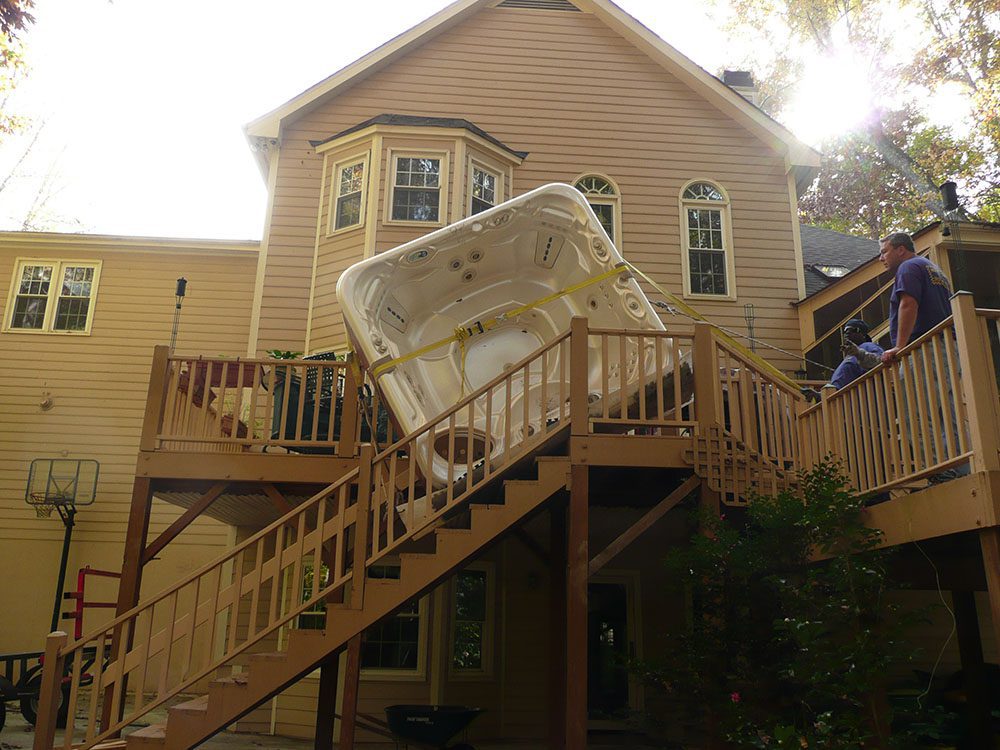
Not every hot tub someone wants gone is actually broken. Moving, downsizing, or simply wanting a different model are common reasons people look into disposal for a perfectly functional spa. If that’s your situation, relocating or selling the tub is often the better outcome, both financially and environmentally, than disposing of something that still has years of life left. We’ve covered what a safe relocation actually involves in our guide on how to move a hot tub safely, and if the tub is heading to a new home across town or across state lines, our piece on how professional movers protect a spa during transport covers what that process looks like in practice.
The Bottom Line
The honest answer to “is it time” almost never comes down to a single symptom. It comes down to whether you’re looking at one fixable problem or several compounding ones, and whether the shell itself, not just a part, is what’s actually failed. Getting a straight answer from someone who isn’t just trying to sell you a solution either way is the fastest route to making the right call.
Since 1994, Hot Tub Taxi has offered both repair and disposal services across the Carolinas, Virginia, Tennessee, Georgia, and Florida, and we’ll tell you honestly which one makes sense for your situation. If you’re not sure whether your hot tub is worth fixing or ready to go, take a look at our Hot Tub Moving Services or call (919) 744-4579 for a straightforward assessment.
Frequently Asked Questions
How do I know if my hot tub is worth repairing?
Get an actual repair estimate rather than assuming. As a general guideline, if the total repair cost approaches half or more of what a comparable replacement would cost, or if multiple major components are failing at once, disposal usually makes more financial sense. A single isolated repair on an otherwise sound tub is almost always worth fixing.
How long do hot tubs typically last?
Well-maintained hot tubs commonly last 10 to 15 years, though this varies based on usage, water chemistry maintenance, and climate exposure. Components like pumps and heaters often need replacement before the shell itself does.
Can I just put my old hot tub out with the trash?
No. Hot tubs require specialized disposal due to their size, electrical components, and materials, and most municipal trash services won’t accept them. A professional removal and disposal service handles the disconnection, breakdown, and proper disposal or recycling of materials.
Is it cheaper to repair or replace an old hot tub?
It depends entirely on what’s actually wrong. A single component failure is usually far cheaper to repair than replace. Multiple simultaneous failures, a cracked shell, or a tub already well past its typical lifespan often make replacement the more cost-effective long-term choice once ongoing energy costs are factored in.