
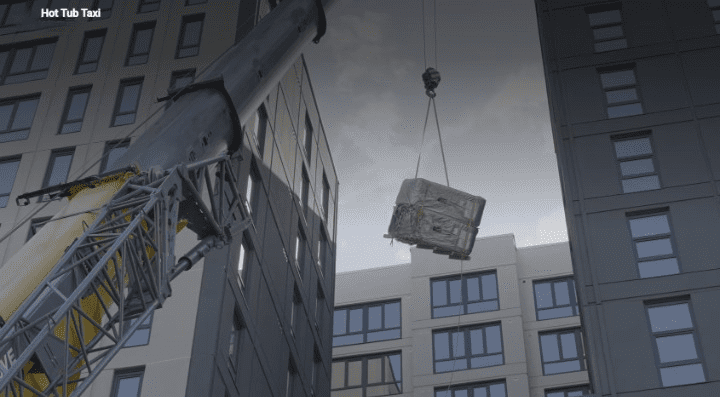
You’ve finally picked out the perfect hot tub. You’ve cleared the spot in the backyard, lined up the electrician, and are counting the days until that first soak. Then the delivery team shows up, takes one look at your fence, gate, or sloped lot, and tells you the standard dolly-and-skid approach won’t work.
That’s when crane-lift hot tub delivery comes into the conversation.
A crane lift is the safest (and sometimes the only) way to get a heavy spa into a backyard when traditional access is blocked. But not every job needs one, and the cost varies a lot depending on your property, your tub, and the crane operator. Below, we’ll break down exactly when a crane hot tub delivery is required, what it actually costs in 2026, and what to expect on delivery day.
What Is Crane-Lift Hot Tub Delivery?
Crane-lift hot tub delivery is the process of using a hydraulic crane to safely lift a hot tub or swim spa over an obstacle, typically a fence, house, deck, garage, or section of landscaping, and lower it precisely onto its prepared pad.
Standard hot tub delivery uses dollies, skids, and straps to roll or carry the tub from the truck to its final spot. That works for maybe 80% of installations. The other 20% physically cannot be moved that way because something is in the path that can’t be gone around, over, or through. A crane gets the tub over that obstacle in minutes instead of hours, and without damaging your property in the process.
Most modern hot tubs weigh between 700 and 1,200 pounds dry, and large swim spas can hit 2,500 pounds or more. Even small cranes can handle that easily, but the truck has to be properly sited, the lift has to be properly rigged, and the operator has to know what they’re doing. This is not a DIY job.
When Do You Need a Crane to Move a Hot Tub?
You’ll need a crane lift if any of the following apply to your property:
- Fenced backyard with no removable section. If your fence is a permanent privacy fence (vinyl, brick, stone, or composite) and there’s no double gate, a crane is almost always the answer.
- Narrow gates or pathways. Most hot tubs are 7 to 8 feet wide. If your gate is under 6 feet, you’ll need to either remove a section of fence or call in a crane.
- Steep slopes, retaining walls, or terraced yards. Hauling a 1,000-pound tub up an incline is dangerous for both crew and equipment.
- Decks above ground level. If your hot tub is going onto a second-story deck, balcony, or rooftop, a crane is the only safe option.
- Recessed or in-ground installations. Tubs going into a sunken patio or below grade often need to be set in from above.
- Landscaping obstacles. Mature trees, hardscaping, ponds, irrigation systems, or other features in the path of a manual carry.
- Pool decks with no side access. Common with hot tubs being added next to existing pools.
- HOA or property restrictions. Some neighborhoods don’t allow heavy equipment on driveways or lawns; a crane lift from the street is the workaround.
If you’re not sure whether your property needs a crane, the easiest move is to send us a few photos. We’ll tell you straight up whether a manual delivery will work or if you need to budget for the lift. Contact us here with a couple of photos of your access point, and we’ll let you know within the day.
How Much Does Crane-Lift Hot Tub Delivery Cost in 2026?
In most of the Southeast, crane-lift hot tub delivery costs between $700 and $2,500, with the average residential job landing in the $900 to $1,500 range. The total depends on five main factors:
1. Crane Size Required
A small 15-ton boom truck can handle most standard residential hot tub lifts and runs roughly $500 to $900 for a one- to two-hour minimum. Larger 30 to 50-ton cranes, needed for swim spas or longer reach over a house, run $1,200 to $2,000 or more.
2. Distance and Reach
The further the crane has to reach over an obstacle, the bigger the boom needs to be, and the bigger the boom, the higher the price. A simple lift over a 6-foot fence is cheap. A lift over a two-story house with 60 feet of reach is not cheap.
3. Hot Tub Weight and Size
A standard four- to six-person hot tub at 700 to 900 pounds is straightforward. A nine-person swim spa, pushing 2,500 pounds dry, needs heavier rigging and a stronger crane.
4. Time Required
Most residential lifts take 60 to 90 minutes from setup to teardown. If your site is tight, the rigging is complex, or there’s traffic control involved, expect a two- to four-hour bill.
5. Location and Permits
Some city streets and HOAs require permits or off-duty police for traffic control during a crane lift. That’s an extra $100 to $500 on top of the base price, depending on the municipality.
Here’s a realistic ballpark for the most common 2026 scenarios in NC, SC, VA, GA, and FL:
- Standard hot tub over a 6-foot fence: $700 to $1,200
- Hot tub onto a second-story deck: $1,200 to $1,800
- Swim spa over a house: $1,800 to $2,500+
- Multi-tub job (drop one, lift the other): $1,500 to $2,200
Want a real number for your specific situation? Request a free estimate, and we’ll quote you the same day.
What Happens on Crane Delivery Day: The Process Step-by-Step
If you’ve never been through a crane lift before, here’s exactly what you can expect when the team rolls up.
Step 1: Site Walk and Setup
The crew arrives, parks the crane truck in the optimal spot (usually the street or driveway), and walks the path from the truck to the final hot tub location. They’ll identify any overhead obstacles like power lines, tree limbs, or eaves and confirm the lift plan.
Step 2: Outriggers and Stabilization
The crane operator extends the outriggers — the heavy hydraulic legs that lock the truck in place — and levels the rig. This is non-negotiable on every lift, even on flat pavement.
Step 3: Rigging the Hot Tub
The tub is wrapped in heavy-duty lifting straps, typically at four points, and connected to the crane’s hook. The crew checks that the straps are positioned to avoid damage to the cabinet and that the load will balance properly when lifted.
Step 4: The Lift
The operator slowly raises the tub, swings it over the obstacle, and lowers it toward the prepared pad. A ground crew on the far side guides the descent with tag lines so the tub touches down exactly where it’s supposed to.
Step 5: Final Placement and Inspection
Once the tub is set, the straps are removed, and the crew walks the install to confirm the pad is level, the tub is square, and nothing was damaged during the lift. Photos are taken for the file.
Total time on site for a standard residential lift: about 90 minutes. If you want a deeper breakdown of how long different parts of the moving process take, we covered it in detail in our guide on how long it takes to move a hot tub.
Crane Lift vs. Manual Hot Tub Delivery: Which Do You Need?
The simplest way to decide is to look at the path from your driveway to the final spot. If a 7-foot-wide, 1,000-pound box can roll along that path without going over anything, manual delivery is fine and far cheaper. If anything blocks the path that can’t be temporarily removed, you’re looking at a crane lift.
Here’s the head-to-head:
- Manual delivery: $200 to $600 typical, takes 1 to 3 hours, requires clear ground-level access.
- Crane-lift delivery: $700 to $2,500 typical, takes 60 to 120 minutes on site, works for almost any obstacle.
One thing a lot of homeowners don’t realize: trying to force a manual delivery on a property that really needs a crane is the most common way hot tubs get damaged. Cracked shells, broken cabinets, and torn equipment bays often start with a crew trying to muscle a tub through a too-tight space. We covered this and other expensive mistakes in our post on hot tub moving mistakes that can cost you thousands.
Why You Should Hire a Pro (Not Rent a Crane Yourself)
Every few months, we get a call from a homeowner who tried to coordinate their own crane rental to save a few bucks and ended up with a damaged tub, a damaged house, or both. Here’s why this almost never works:
- Rigging is a learned skill. Hot tubs are top-heavy and unevenly weighted. The straps have to be positioned exactly right, or the tub will tilt during the lift and crack.
- Insurance won’t cover DIY damage. Most crane rental companies require licensed riggers, and your homeowner’s insurance won’t touch a self-coordinated crane job either.
- Site planning matters. Where the truck parks, how the boom swings, and where the ground crew stands—none of it is obvious if you’ve never done it.
- Permits and traffic control. A pro crew handles street permits and police details. A DIY job leaves you negotiating with the city.
When you book a crane-lift hot tub delivery with a licensed and insured pro, you get one bill, one accountable party, and one team that handles everything from the truck to the final placement. Hot Tub Taxi has been doing this since 1994; there isn’t a backyard setup we haven’t seen.
How to Prepare Your Property for a Crane-Lift Delivery
A little prep on your end makes the lift go smoother (and sometimes shaves time off the bill). Here’s the short list:
- Confirm your pad is ready. The pad, concrete slab, gravel base, or reinforced deck needs to be poured, leveled, and fully cured before delivery day.
- Clear the path under the lift. Move patio furniture, grills, planters, and anything else in the swing path. Anything fragile under the lift should be relocated.
- Trim overhead branches. Tree limbs that hang over the lift zone need to come down, or the crane can’t extend through them.
- Mark utilities and irrigation. Outriggers can crush sprinkler heads and drip lines. Call 811 if you’re unsure where buried lines run.
- Keep pets and kids inside. Lift days are an exciting backyard event, but not a safe one.
- Have the electrician scheduled for after the lift. Hot tub wiring happens once the tub is in place. Don’t book the electrician for the same morning as delivery.
For a complete pre-move and post-move checklist, our Hot Tub Moving Checklist walks through every step from before delivery through fill-and-fire-up.
Frequently Asked Questions About Crane-Lift Hot Tub Delivery
How long does a crane-lift hot tub delivery take?
Most residential lifts take 60 to 90 minutes from arrival to departure. Complex jobs with long reach or multiple tubs can run 2 to 4 hours.
Can you crane a hot tub over a two-story house?
Yes — but it requires a larger crane (typically 30-ton or higher) and more reach. Expect costs at the higher end of the range, usually $1,800 to $2,500 or more.
Do I need a permit for a crane lift on my property?
If the crane is set up entirely on your private property and not blocking the street, usually no. If the truck has to park on a public street or sidewalk, the municipality may require a right-of-way permit and sometimes an off-duty officer for traffic control.
Is crane-lift delivery covered by my hot tub dealer?
Sometimes, many dealers include “standard delivery” in the purchase price but charge separately for crane lifts. Always ask before you buy. If your dealer doesn’t handle complex deliveries, that’s where we come in.
Can the same crane be used to remove an old hot tub and install a new one?
Yes, and this is the most cost-effective way to do a swap. A single crane setup handles both lifts and saves you a second mobilization fee.
What if it rains on delivery day?
Light rain is usually fine. Heavy storms, high winds, or lightning will push the lift to the next available day; crane operators won’t work in unsafe weather, and you wouldn’t want them to.
Ready to Schedule a Crane Lift in NC, SC, VA, GA, or FL?
Hot Tub Taxi has been doing crane-lift hot tub deliveries across the Southeast since 1994. We’re based in Raleigh and Charlotte and regularly run jobs throughout Greensboro, Burlington, Wilmington, Myrtle Beach, and the rest of NC, SC, VA, TN, GA, and FL.
If your backyard has a fence, a slope, a deck, or anything else in the way, don’t risk a manual delivery gone wrong. Get a real quote from a team that’s been lifting tubs over obstacles for three decades.
Request your free crane-lift estimate today or call us directly at (919) 744-4579.