
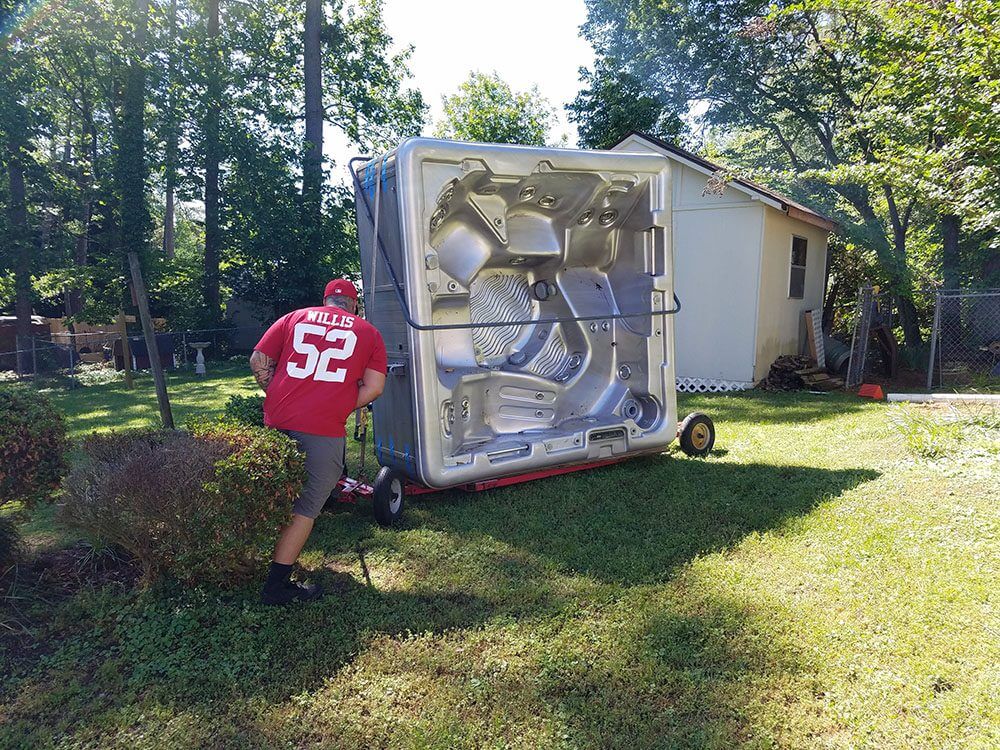
Rent an appliance dolly rated for 800 pounds, strap a 700-pound hot tub to it, and on paper, the math works. In practice, it usually doesn’t, and it’s not because the weight rating was wrong. It’s because a hot tub isn’t shaped, balanced, or built like the things that Dolly was designed for.
Most articles about moving a hot tub mention equipment as one line in a longer checklist: “You’ll need a dolly, some straps, and moving blankets.” That’s true as far as it goes, but it treats equipment as an afterthought rather than as the actual answer to a specific set of physical problems. After 25+ years of moving spas and swim spas across the Carolinas and neighboring states, the pattern is consistent: nearly every DIY move that goes wrong traces back to a mismatch between the equipment on hand and how a hot tub behaves under load. This post walks through why, problem by problem.
A Hot Tub Isn’t Heavy Furniture: It’s a Different Engineering Problem
A refrigerator is heavy, but it’s a rigid box with a flat, uniform base and a predictable center of gravity. A hot tub is a different animal entirely. It’s a large, mostly hollow acrylic or rotomolded shell wrapped in a wood or synthetic cabinet, with a compressor, pumps, plumbing, and a heater concentrated on one side or in one corner. Most modern hot tubs weigh 700 to 1,200 pounds dry, and large swim spas can weigh 2,500 pounds or more. None of that weight is evenly distributed, none of it sits on a surface built to be dragged or rolled, and the shell that makes up most of the tub’s visible surface area isn’t structural. It’s not designed to bear the load from a strap or a dolly platform pressed against it.
That combination, high weight, uneven distribution, a non-structural outer shell, and an awkward, non-rectangular footprint, is what generic moving equipment isn’t built to handle. Below are the specific problems a hot tub move presents and the piece of equipment that addresses each one.
Problem: The Shell Can’t Bear Concentrated Weight
A standard two-wheel hand truck or appliance dolly makes contact with a load at a handful of narrow points: a strap across the middle, a lip under the base. That works fine for a box or a rigid appliance. Pressed against a hot tub’s cabinet or shell, those same narrow contact points concentrate hundreds of pounds onto a small area of a surface that was never engineered to carry point loads, which is exactly how cabinets crack, and shells develop stress fractures that don’t show up until weeks later.
What solves it: a wide, flat spa dolly or hydraulic lift platform designed to support the tub’s full base, distributing weight across the largest possible surface area rather than concentrating it at a few points. This is the single biggest reason a rented furniture dolly is the wrong tool, even when its weight rating technically exceeds the tub’s weight: the rating describes how much it can hold, not how safely it distributes that load on a surface that isn’t built to be squeezed.
Problem: The Weight Isn’t Balanced
Because the equipment pack, pumps, and plumbing sit concentrated on one side, a hot tub doesn’t roll or tip the way a symmetrical object does. Lift or roll it without accounting for that offset, and it will rotate toward the heavy side, which is how tubs end up tipping off a dolly or straining unevenly against straps positioned as if the load were centered.
What solves it: multiple rated tie-down straps positioned at specific points around the tub’s frame, not just one strap looped wherever is convenient, along with a crew that understands where the equipment pack sits and adjusts positioning accordingly. Ratchet straps rated for the load matter here specifically because bungee cords and light-duty rope stretch and shift under an off-center load in a way that rated ratchet straps don’t.
Problem: Doorways, Stairs, Gates, and Decks Aren’t Built for This Shape
A hot tub’s dimensions rarely cooperate with a standard doorway, gate, or stairwell. Even when the width technically clears, the diagonal clearance needed to angle the tub through a turn often doesn’t, and that’s before accounting for stairs, sloped yards, or a second-story deck with no ground-level path at all.
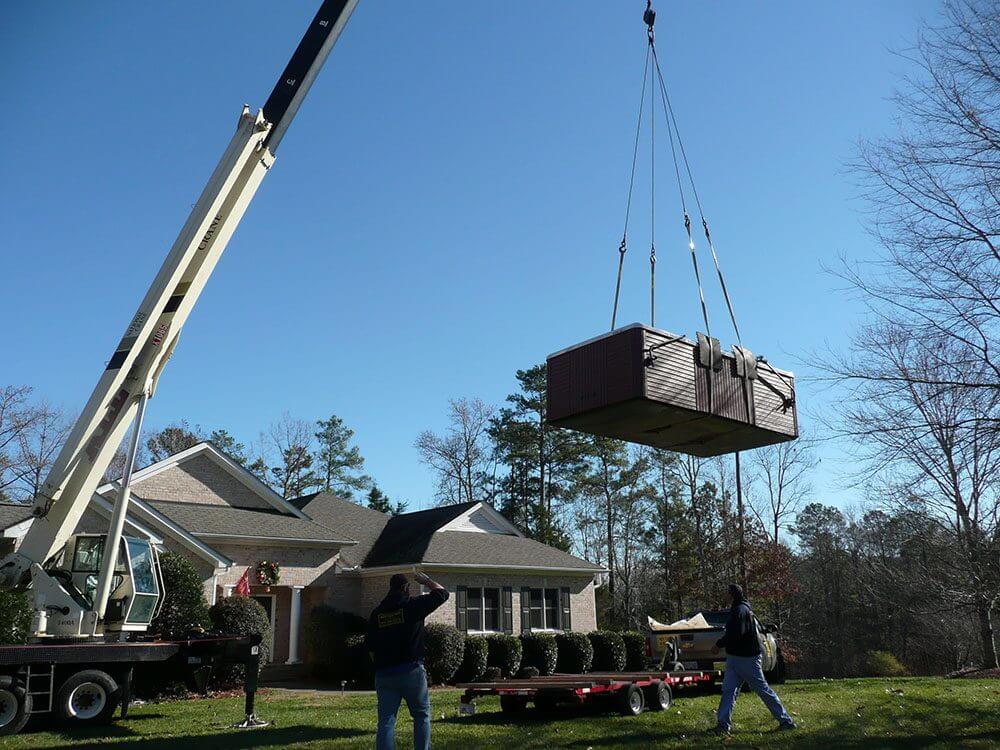
What solves it: for straightforward, flat-access moves, stair-capable dollies and a properly sized crew handle the job. For the roughly one in five moves where the path is blocked entirely by a fence, a house, a retaining wall, or a deck with no clear route, a hydraulic crane lifts the tub over the obstacle rather than forcing it through. Crane operation is a certified skill, governed by standards from the National Commission for the Certification of Crane Operators, and it’s not equipment a homeowner rents for a weekend. This is the point where our crane-lift hot tub delivery guide covers when a lift is the right call and roughly what it costs.
Problem: The Tub Has to Survive Transport, Not Just the Yard
Getting the tub from the patio to the driveway is only half the equipment problem. Once it’s on a truck or trailer, it needs to stay exactly where it was placed through turns, stops, and highway speeds, without the shell resting on anything that can crack it.
What solves it: a flatbed or trailer with proper anchor points, the tub secured on its cabinet side (never the acrylic shell, which isn’t structural), and blocking or bracing to prevent shifting. This is also where floor and surface protection matters on both ends: skid plates or plywood runners keep the tub’s base from grinding against pavement, decking, or flooring during loading and unloading, protecting both the tub and the property.
Problem: The Weight Exceeds Safe Manual Lifting Limits
Even with the right dolly and straps, a hot tub’s weight is well beyond what any number of people should be lifting by hand at any single point. The Occupational Safety and Health Administration recommends mechanical assistance for loads well below what a single hot tub weighs, which is exactly why the equipment described above exists: it’s not about convenience, it’s about keeping the load’s weight on wheels, straps, and rated hardware instead of on people’s backs and shoulders.
Why “Rated for the Weight” Isn’t the Same as “Right for the Job”
This is the point most equipment checklists skip entirely, and it’s worth stating plainly: a piece of moving equipment can carry the correct weight rating and still be the wrong tool. A furniture dolly rated for 1,000 pounds is built for a load that’s rigid, evenly distributed, and roughly rectangular. A hot tub is none of those three things. The mismatch isn’t in the number on the label; it’s in the shape of the problem the equipment was designed to solve. Specialized spa-moving equipment, wide-platform dollies, hydraulic lifts, rated multi-point strapping, and crane rigging are used when access demands it, because someone worked backward from the specific ways a hot tub’s shell, weight distribution, and dimensions behave under load, not forward from a generic weight rating.
We’ve written more broadly about the most common and costly mistakes homeowners make on DIY moves, and equipment mismatches like this one show up constantly in that list.
When a Straightforward Move Doesn’t Need All of This
To be fair to the DIY guides out there: a short, flat, ground-level move of a smaller tub with wide clearances genuinely doesn’t require a crane or a full commercial rigging setup. If that describes your situation, our step-by-step guide to moving a hot tub safely walks through the process, including the specific dolly and strapping technique that works for a low-complexity move.
Where equipment stops being optional is stairs, sloped or uneven terrain, tight gates, second-story decks, older tubs with more fragile shells, or swim spas at the upper end of the weight range. At that point, the gap between “technically possible with rented gear” and “actually safe” widens fast.
What This Looks Like With a Professional Crew
At Hot Tub Taxi, every move starts with an assessment of the path, not just the tub, because the equipment needed depends entirely on what’s between the spa and the truck. That might mean a spa dolly and rated straps for a straightforward relocation, or a full crane setup for a tub that has to clear a fence, a roofline, or a retaining wall. We’ve been doing this since 1994, and the equipment list has grown specifically because generic moving gear kept failing due to the specific physics of hot tubs, not because more tools make for a better sales pitch.
Ready to move your hot tub? Contact Hot Tub Taxi today for a free quote and let our experienced team handle your spa move safely and efficiently.
FAQ: Hot Tub Moving Equipment
What equipment do you need to move a hot tub?
At a minimum: a wide-platform spa dolly or hand truck rated for the tub’s weight, multiple rated tie-down or ratchet straps, moving blankets or padding for the cabinet, and a properly sized crew, generally three to four people. For tight access, stairs, or obstacles that can’t be routed around, a hydraulic crane and rigging equipment are needed as well.
Can you move a hot tub with a regular furniture dolly?
For a very short, flat, low-complexity move of a smaller tub, sometimes. But a standard furniture dolly concentrates weight at narrow contact points rather than distributing it across the tub’s base, which is a common cause of cabinet damage and shell stress fractures. A wide-platform spa dolly built for this shape and weight distribution is the safer choice for anything beyond the simplest move.
Do you need a crane to move a hot tub?
Not always. Roughly 80% of hot tub relocations can be handled with dollies, skids, and straps alone. A crane becomes necessary when something in the path, a fence, a house, a deck, or landscaping, can’t be gone around, over, or through any other way.
How many people does it take to move a hot tub?
Most residential hot tubs require at least three to four people, even with the right equipment. Larger swim spas or moves involving stairs or elevation changes typically need more.
Why can’t movers just use the same equipment as for furniture or appliances?
Furniture and appliance dollies are built for rigid, evenly balanced loads with flat, uniform bases. Hot tubs are hollow, unevenly weighted toward the equipment pack, and finished in a non-structural shell that can’t safely bear concentrated point loads. The weight rating on a piece of furniture-moving equipment doesn’t account for any of that.