
Someone measures the gate, measures the tub, and the math doesn’t work. The instinct at that point is to assume the move is off the table. It almost never is. What actually happens next depends less on the gate itself, and more on one detail most articles on this topic skip entirely: whether you’re buying a new tub or moving one you already own.
Why a Tight Gate Isn’t the End of the Move
A hot tub not fitting through a gate as-is doesn’t mean it can’t get through at all. In order of how often each one actually solves the problem: the tub can usually be tilted onto its side, which reduces its footprint enough to clear most residential gates; if that’s still not enough, a section of fence or a gate post can often be temporarily removed; and if neither works, a crane lift over the obstacle entirely is the final option. Since you already own the specific tub in question, the fix has to come from how it moves through your space, not from choosing a different tub.
Why Most Advice on This Topic Doesn’t Quite Fit Your Situation
Nearly everything published about hot tub access assumes you’re standing in a showroom, not a backyard with a tub that’s already yours. Buying guides will tell you to measure your gate before you purchase, or to consider a smaller or modular model if your access is tight. That’s genuinely good advice for someone shopping for a new tub. It does nothing for someone who already owns a specific tub, in a specific size, and needs to move it from one place to another. At that point, the tub’s dimensions are fixed. The only variable left is the route it takes and how it’s handled along the way.
First Option: Turning the Tub on Its Side
This is the move that resolves the vast majority of “it won’t fit” situations, and it’s simpler than it sounds. A hot tub’s full footprint, the width and depth it takes up sitting flat, is almost always wider than the gap needed to move it on its side using a proper dolly and strapping system, following the same kind of safe lifting and handling principles outlined in OSHA’s guidance on manual material handling. Gates that look far too narrow when you picture the tub sitting upright often have plenty of room once the tub’s narrowest dimension is what actually needs to clear the opening. This is the standard first move for a reason: it requires no construction, no additional equipment beyond what a moving crew already brings, and it solves the problem outright in most residential situations.
If Tilting Still Isn’t Enough: Temporary Fence or Gate Removal
When the tilted tub still can’t clear the opening, the next option is usually removing a section of fence or a gate post rather than the tub itself. Many modern privacy fences are built in panel sections that can be detached and reinstalled without much trouble. Older fences, chain link, block walls, or wrought iron, are more involved and may call in a fencing contractor rather than a same-day fix. A few things are worth sorting out before moving day rather than during it: whether the fence is on a shared property line, which means getting a neighbor’s sign-off before touching it, and whether you have pets that need a temporary containment plan while the fence is open.
Terrain Adds a Second Layer Most Gate Discussions Miss
Gate width gets all the attention, but across a lot of the properties we work on throughout the Carolinas, Georgia, Tennessee, and Virginia, slope and obstacles matter just as much. Older neighborhoods with narrower side yards, mature trees close to the house, and yards with a real grade change between the driveway and the backyard are common here in a way they aren’t in a flat suburban subdivision. A gate that’s technically wide enough doesn’t help much if the path behind it climbs a steep grade or winds around a tree that wasn’t there when the fence was built. Assessing the full path, not just the narrowest point, determines whether tilting the tub and rolling it through is realistic or whether you’re looking at a different solution entirely.
When the Answer Is a Crane, Not a Workaround
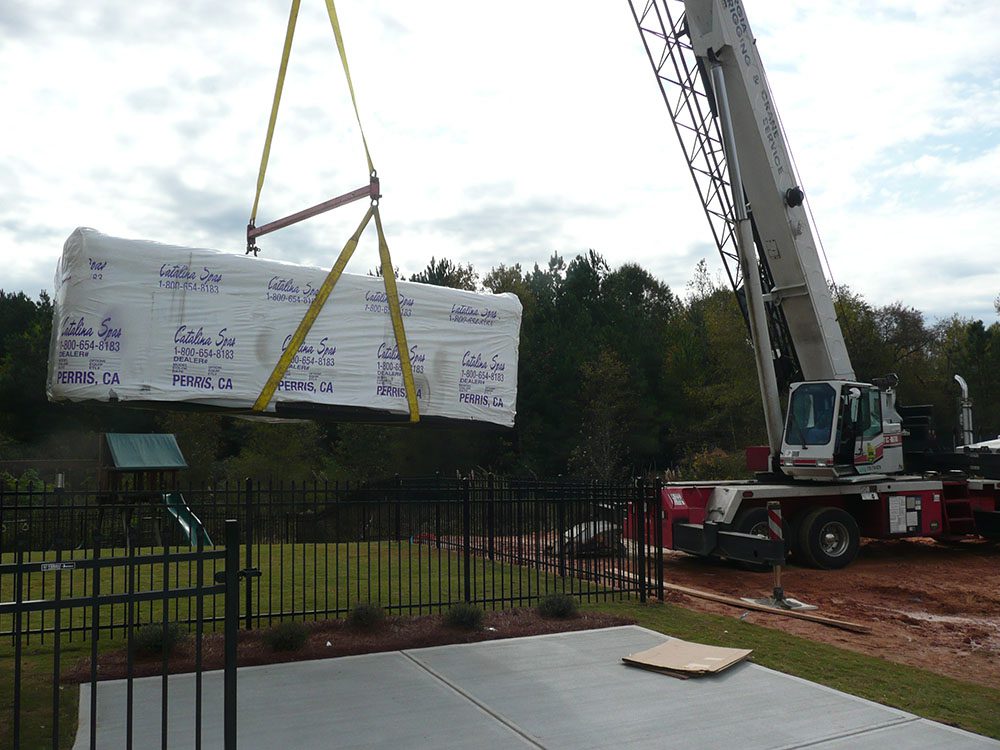
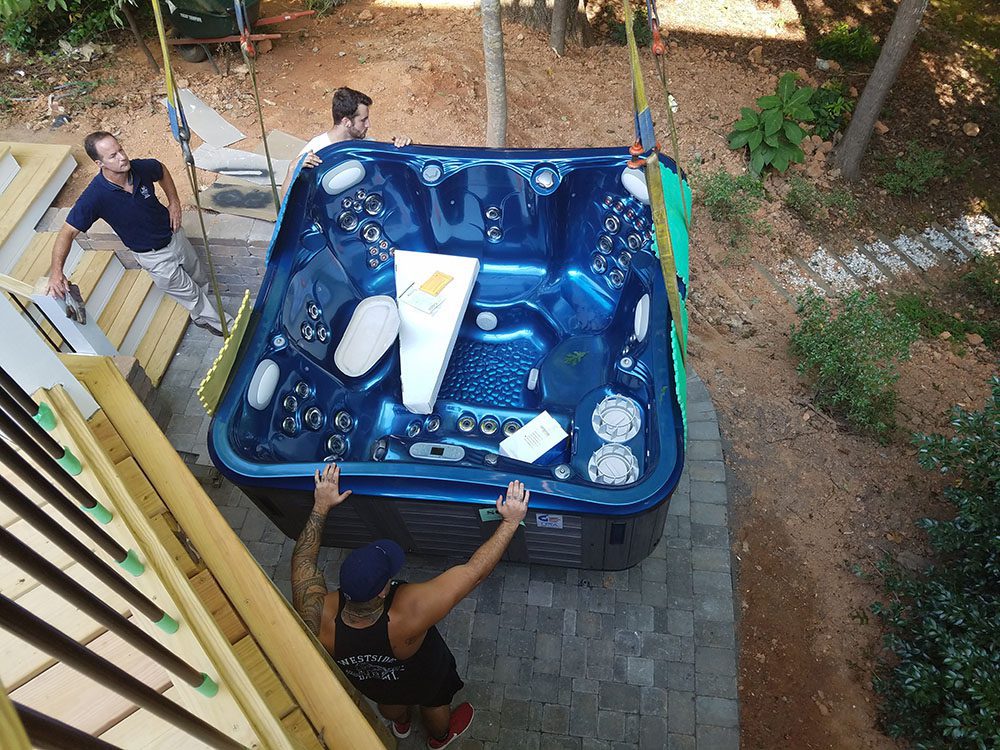
If the tub genuinely can’t be maneuvered through on its side and fence removal isn’t practical, whether due to property lines, terrain, or a fence that can’t come down, a crane lift over the obstacle is the remaining option. This isn’t a project to take on by arranging a bare crane rental yourself; a specialist who handles the entire lift, including the rigging, the site assessment, and the liability that comes with lifting something this heavy over a structure or fence line, is a meaningfully different arrangement than simply hiring equipment and hoping for the best. We’ve covered what actually drives the cost of a crane-assisted move in detail in our guide on crane lift hot tub delivery cost, which is worth a look if this is where your situation is heading.
Why This Is Worth Figuring Out Before Moving Day
A gate that won’t accommodate a tub is exactly the kind of problem that’s far easier to solve with a few days of notice than it is standing in the driveway with a truck already there. Walking the actual path the tub will travel, not just measuring the gate in isolation, is part of a proper pre-move assessment, alongside checking the tub’s own condition. We’ve written more about that broader assessment in our guide on how to know if your hot tub is safe to move, and our overview of how to move a hot tub safely covers the rest of the process once access has been sorted out.
What This Means If Your Gate Won’t Cooperate
A hot tub that won’t fit through a gate as it currently stands isn’t a dead end. It’s a sequence of options, tilting the tub, temporarily adjusting the fence line, or, in rarer cases, a crane lift, and figuring out which one applies to your property is far easier to do ahead of time than on moving day itself.
If you’re planning a move and aren’t sure whether your gate, fence, or terrain will cooperate, Hot Tub Taxi has handled exactly this kind of access challenge across the Carolinas, Virginia, Tennessee, Georgia, and Florida since 1994. Take a look at our hot tub moving services or call (919) 744-4579, and we’ll walk the path with you before moving day, not after.
Frequently Asked Questions
Do all hot tubs need to go through a gate upright?
No. Most hot tubs are moved on their side using a proper dolly and strapping system, which significantly reduces the width needed to clear a gate compared to the tub’s full upright footprint.
Is it safe to remove a fence panel to move a hot tub?
Often, yes, particularly with modern panel-style privacy fencing that’s designed to be removable. Older or more permanent fencing, including chain link or masonry, generally requires a contractor rather than a same-day DIY removal.
What if there’s no way to widen the access at all?
A crane lift over the obstruction becomes the remaining option when tilting the tub and modifying the fence line aren’t realistic. This is a specialized job best handled by a company experienced with hot tub lifts, not a general equipment rental.
Should I measure my gate before scheduling a move?
Yes, and measure the entire path, not just the gate opening. Slope, nearby trees, and utility fixtures along the route can matter just as much as the width of the gate itself, especially on older or hillier properties.